Legality
Intelligence cannot make itself law. Legally consequential outputs require a lawful chain of authority, competence, reason, responsibility, evidence, review and remedy.
Jurisprudence beyond AI governance
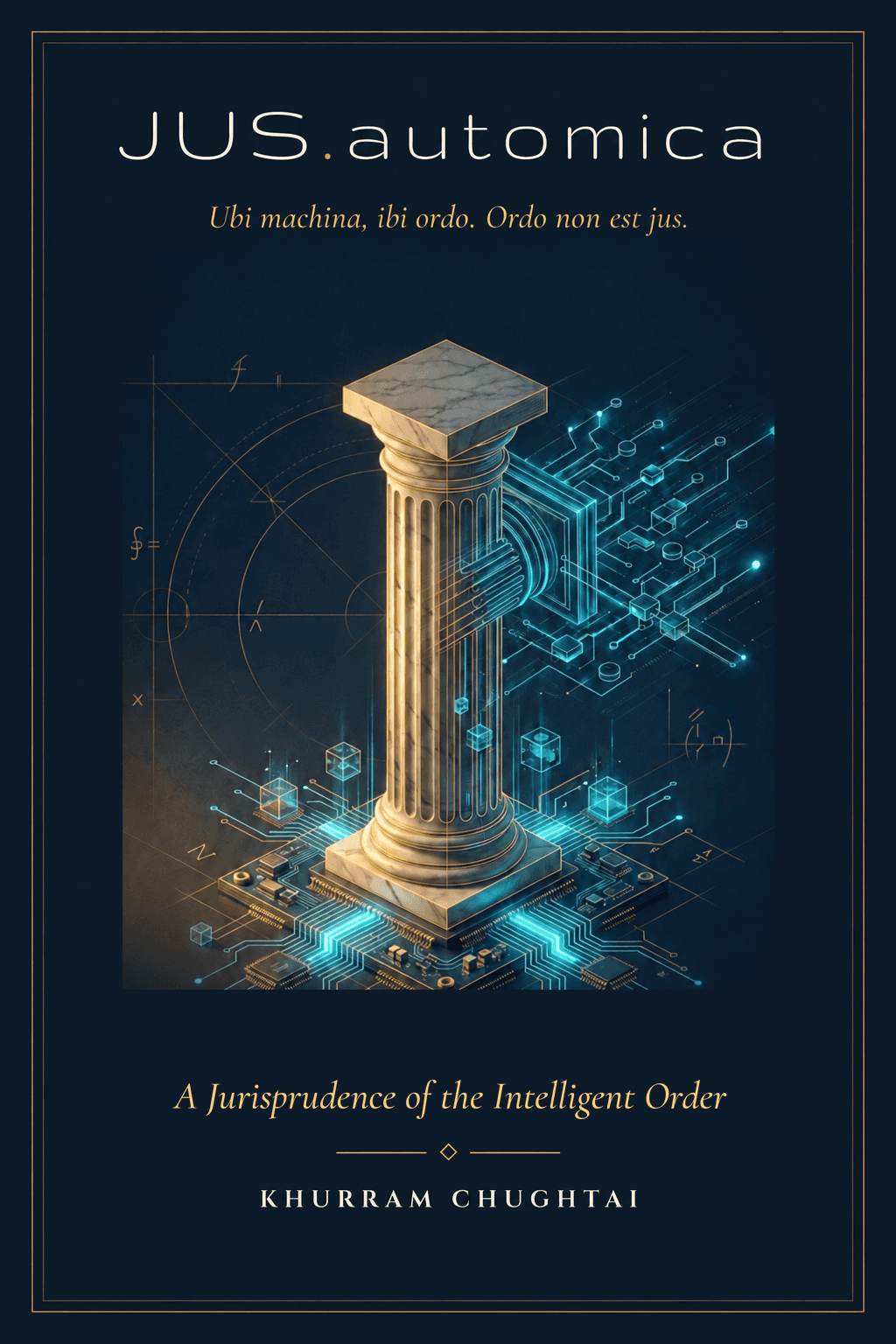
JUS.automica
A jurisprudence for law, authority and governance in the age of intelligent systems.
How can law remain law when intelligence participates in forming, carrying and transforming legal authority?
A foundational jurisprudential inquiry under KSC.JUSNREM
Enter the inquiry ↗01 / The juridical object
JUS.automica examines the validity, authority, constitution, allocation, attribution, operation, evidence, review and remedy of law in an Intelligent Legal Order.
The programme does not begin with the technological object called artificial intelligence. It begins when intelligence materially participates in recognising, interpreting, applying, revising, evidencing or correcting legal norms and public authority.
02 / Three legal conversions
The research follows three connected movements. Each asks what law must do before intelligence-mediated power can become authoritative.
Intelligence cannot make itself law. Legally consequential outputs require a lawful chain of authority, competence, reason, responsibility, evidence, review and remedy.
When intelligence materially participates in public judgment, constitutional law must govern its authority, allocation, attribution, separation and contestability.
Distributed cognition is not self-validating public authority. Cognitive contributions become institutional acts only through competence-bound adoption and legal attribution.
“An institution may distribute cognitive labour, but it may not distribute away legal authority.”Candidate Volume III proposition
03 / Core concepts
Technical output does not create legal authority. The inquiry follows the legal conditions through which intelligence-mediated work may become an attributable, reviewable institutional act.
The prior legal authority to perform, adopt or attribute a legally consequential act.
The accountable institutional act through which cognitive work may acquire legal consequence.
The legal connection between distributed cognitive contributions and a constituted institution.
A traceable record of sources, reasons, transformations, interventions and authoritative decisions.
Practical means to contest, correct, suspend or reverse a legally consequential institutional act.
The discipline of keeping doctrine, records and institutional action open to sourced challenge.
04 / Doctrinal boundary
05 / Research programme
Subsequent volumes remain within the controlled research architecture and will be introduced as their propositions mature.
What makes law valid and authoritative when intelligence participates in its formation and operation?
How is authoritative intelligence constituted, distributed, attributed, limited and retained under constitutional authorship?
How does distributed cognitive labour become an attributable act of a legally constituted institution?
06 / Research discipline
JUS.automica distinguishes an original research programme from an assertion of completed originality. Its propositions remain exposed to competing doctrine, primary law, institutional practice and correction.
07 / Publication record
Publication does not convert a candidate proposition into established law or an institutional deployment.
08 / Open research
The programme welcomes competing doctrines, counterexamples, jurisdictional sources, institutional cases and criticism of its legal thresholds.