JUS.automica
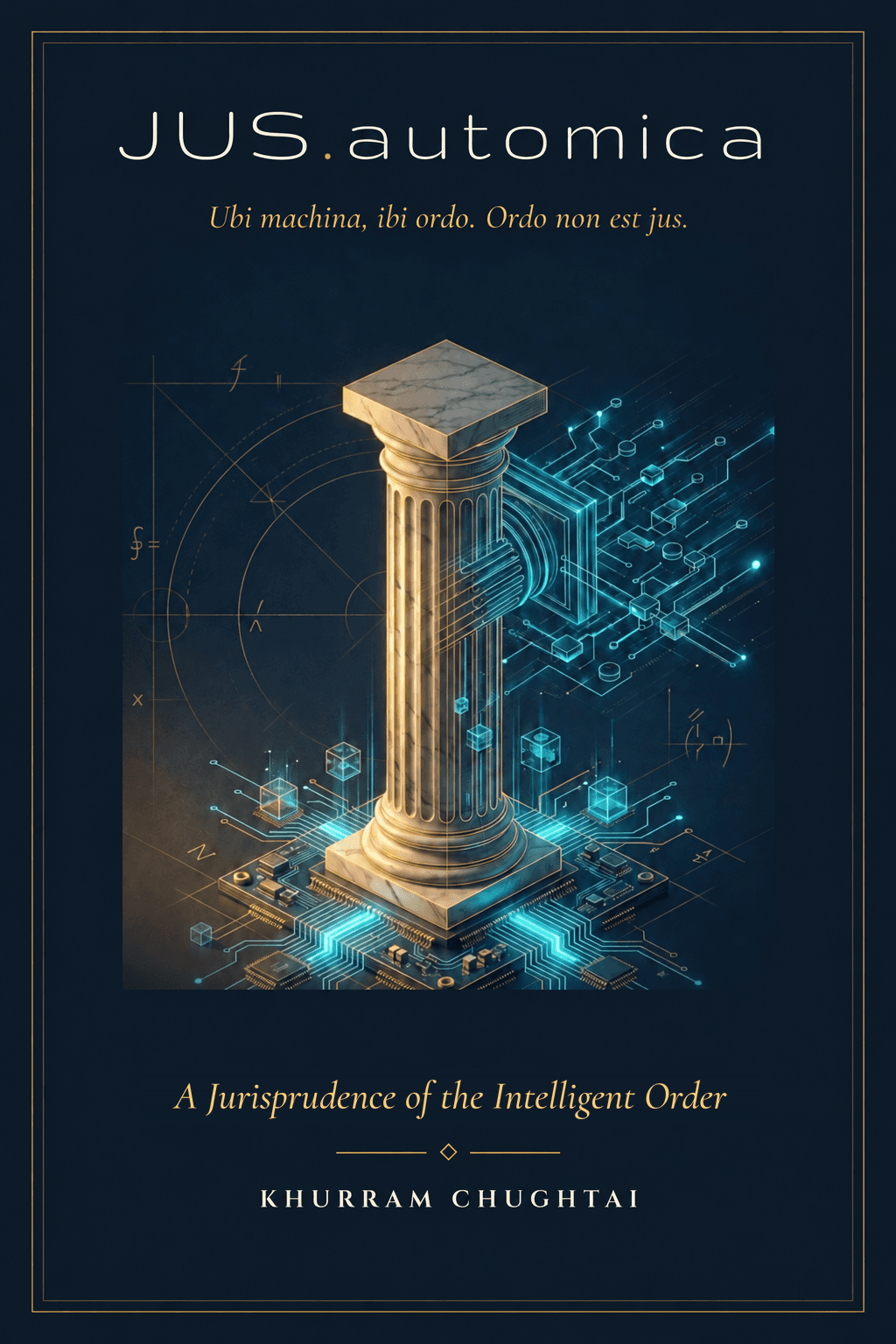
Cover of JUS.automica: A Jurisprudence of the Intelligent Order, by Khurram Chughtai, beneath the maxim Ubi machina, ibi ordo. Ordo non est jus.

The Book · Publication manuscript of 13 October 2026

One book. Twenty-eight chapters.

JUS.automica: A Jurisprudence of the Intelligent Order, by Khurram Chughtai. This book comprises twenty-eight chapters on the jurisprudence of the Intelligent Order. It examines the Intelligent Legal Condition, the intellectual genealogy of law and code, authority and rights, the definition and doctrines of the subject, and the foundational canons.

Each chapter answers one governing question. Below are the questions, the doctrines the chapters develop, a summary of each and its main sections; the book closes with a practitioner apparatus of audit questions and identity cards, a bibliography, a glossary and an analytical index. The chapter text is read in the Codex, by members and owners of the Book.

Or express interest as a reader, reviewer, library or press.

The central thesis

Ubi machina, ibi ordo. Ordo non est jus.

An operative order does not become lawful authority merely because it works.

Legality must remain intelligible and answerable throughout the chain from source and interpretation to representation, execution, evidence, review and correction. Computational capacity cannot supply its own authority.

What the book examines

The Intelligent Legal Condition; the intellectual genealogy of law and code; authority and rights; the definition and doctrines of the subject; and the foundational canons, in twenty-eight chapters that build on one another.

Twenty-one doctrines

The book states 21 named doctrines, each a proposed formulation located in the chapter that develops it. The doctrines, chapter by chapter.

Forms of engagement

Readership, library and teaching interest; chapter and disciplinary review; primary sources, institutional evidence and counterexamples; comparative and Islamic jurisprudential contributions; translation. An expression of interest creates no obligation, fee, appointment, authorship entitlement or transfer of rights.

Chapter openers

One sentence and one figure open a chapter.

Five opener proofs, retained as apparatus. Each fixes an inquiry and says what it leaves open.

JUS.automica

Chapter 03

Legal Translation into Computational Systems

A legal rule becomes executable through accountable transformations; fidelity depends on who owns the choices between them.

  1. Source

    Which legal text governs?

    then
  2. Authoritative reading

    Which meaning is adopted?

    then
  3. Specification

    Which facts, tests and exceptions?

    then
  4. Implementation

    How are those choices realised?

    then
  5. Execution

    What happens in this case?

Each material choice

  • An identified decision-maker
  • A sufficient legal mandate
  • An examinable record
Challenge and correction

Drafting, design and defence must keep these connections owned.

Reading the figure

Solid arrows show transformations, not a compulsory development sequence. The return route locates correction at the material choice; settled technical operations need not reopen interpretation.

Source: Chapter 3, sections 3.3.2 to 3.3.5.

JUS.automica

Chapter 06

Positivism, Legal Validity and Computational Authority

Operational success does not establish legal authority. A material pedigree question can be established, disproved or still unknown.

Recognised source

status and scope

Competent institution

power and limits

Authorised implementation

material choices

Material pedigree

Established

Continue to reasons, fidelity and lawful application.

Unknown

Refuse automated finality; obtain evidence or competent determination.

Proved absent

Identify the defect and the consequence under governing law.

Preserve evidence and independently grounded rights in the interim.

Reading the figure

These are different findings. Unknown authority withholds automated finality; proved absence calls for the governing law’s consequence. A sound pedigree does not decide every further issue of legality.

Source: Chapter 6, sections 6.5.5 and 6.6.3.

All five openers

Contents

Twenty-eight chapters, question by question.

Search every chapter's title, question, doctrine, summary, keywords and section headings, or choose a keyword. Open a chapter to read its summary and sections.

All 28 chapters

The apparatus

  • Abbreviations
  • Table of Cases
  • Table of Legislation and Instruments
  • Practitioner apparatus: audit questions and identity cards
  • Bibliography
  • Glossary
  • Analytical index

Download

The contents and chapter summaries

A printable booklet with every chapter’s question, doctrine, summary, keywords and sections, and the table of twenty-one doctrines. Free to share and cite.

Download the PDFRead it online

How the Book is sold

A pre-order is a promise with a date on it.

What you buy

The digital edition of the whole book, its twenty-eight chapters with the practitioner apparatus, bibliography, glossary and analytical index, in the Codex reader and as a download, and every chapter in the Codex from the day of purchase.

What you can read now

Every chapter's question, doctrine, summary and sections, here and in the downloadable contents, free of charge.

If you change your mind

A pre-order may be refunded in full at any time before the Book is delivered, with one message to contact@ksc-jusnrem.io.